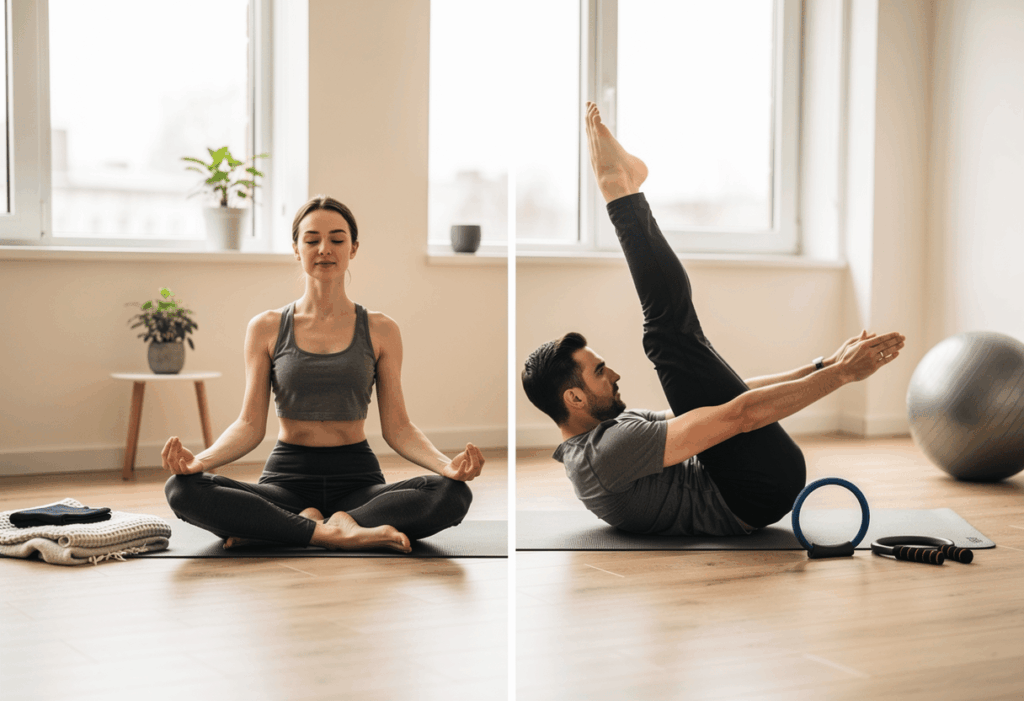
At a glance, yoga and Pilates can look similar: both are low-impact practices, performed on a mat, focusing on controlled movement and breathing.
However, the difference between yoga and Pilates lies in their origins, goals, and the way the body is engaged. Yoga emphasizes flexibility, balance, and mental focus, while Pilates prioritizes core strength, posture, and controlled muscle activation.
Understanding these differences helps you choose the practice that best fits your body, goals, and lifestyle.
Key points :
- Yoga focuses on flexibility, breath, and mind-body connection.
- Pilates targets core strength, posture, and controlled movement.
- Both improve mobility, but through different physical and mental approaches.
Yoga originates from ancient traditions, with roots in physical, mental, and sometimes spiritual practices. Pilates, on the other hand, is a modern exercise method, designed to improve functional strength and body alignment. This fundamental distinction explains why the experience and the results can feel very different.
Origins and philosophy: two very different backgrounds
One of the easiest ways to understand what’s the difference between yoga and Pilates is to look at where each practice comes from.
Yoga: an ancient holistic discipline
Yoga dates back thousands of years and was originally developed as a system to align body, breath, and mind. Physical postures are only one part of the practice. Breath control and mental focus are equally important.
Yoga sessions often emphasize:
- Flexibility and joint mobility
- Controlled breathing patterns
- Balance and body awareness
- Mental calm and stress reduction
This makes yoga particularly appealing to people seeking relaxation, mobility, or a stronger mind-body connection.
Pilates: a modern method focused on movement efficiency
Pilates was developed in the 20th century with a very different objective: strengthening the body from the inside out. The method focuses on precise, controlled movements designed to support posture and prevent injury.
Pilates training emphasizes:
- Core muscle engagement
- Spinal alignment
- Controlled breathing linked to movement
- Functional strength rather than flexibility alone
This difference in philosophy explains why Pilates is often recommended in rehabilitation or posture-focused programs.
How the body works differently in yoga and Pilates
Although both practices involve slow, controlled movements, the way muscles are activated differs significantly.
Muscle engagement and intensity
Yoga poses often involve holding positions for longer periods, which improves flexibility and muscular endurance. Pilates movements are usually more dynamic and repetitive, targeting deep stabilizing muscles.
In practical terms:
- Yoga encourages muscles to lengthen and relax
- Pilates trains muscles to contract with precision
This distinction matters if your goal is either to increase range of motion or to build functional strength and postural control.
Breathing techniques: similar but not identical
Breathing plays a central role in both practices, yet it serves different purposes.
- In yoga, breathing is often slow and rhythmic, supporting relaxation and concentration.
- In Pilates, breathing is coordinated with effort, helping stabilize the core and control movement.
A useful reference point: Pilates breathing supports strength and control, while yoga breathing supports relaxation and awareness.
Yoga vs Pilates: benefits and who each practice is best for
When comparing what’s the difference between yoga and Pilates, the most practical approach is to look at the benefits for the body and the type of person each method suits best.
Physical benefits: flexibility or strength?
Yoga is particularly effective for:
- Improving flexibility and joint mobility
- Reducing muscle tension and stiffness
- Supporting relaxation and stress management
Pilates, by contrast, is more focused on:
- Strengthening the core muscles
- Improving posture and spinal stability
- Enhancing coordination and movement control
In short, yoga tends to lengthen muscles, while Pilates aims to strengthen and stabilize them.
Key data : Pilates places a strong emphasis on deep abdominal muscles, which play a major role in posture and lower back support.
Mental and lifestyle considerations
Yoga often appeals to people looking for:
- A calmer practice with a mind-body focus
- Stress relief and better breathing habits
- A more introspective or meditative experience
Pilates is usually preferred by those who want:
- A structured, goal-oriented workout
- Better posture for daily activities
- Support for injury prevention or rehabilitation
Which one should you choose?
If your priority is flexibility, relaxation, and balance, yoga may be the better fit.
If your goal is core strength, posture, and controlled movement, Pilates is often more suitable.
In reality, many people benefit from combining both practices, as they complement each other rather than compete.
Intensity, calorie burn, and accessibility
Another way to understand what is the difference between yoga and Pilates is to compare how demanding each practice feels on the body and how easy it is to start.
Intensity and physical effort
Yoga intensity varies widely depending on the style. Some classes are slow and gentle, while others can be physically demanding and dynamic. Pilates tends to maintain a consistent level of muscular engagement, especially in the core, even when movements look subtle.
In general:
- Yoga can range from very gentle to highly athletic
- Pilates usually feels moderately intense but very targeted
Calorie burn: not the main goal, but still relevant
Neither yoga nor Pilates is designed primarily for weight loss. However:
- Pilates may burn slightly more calories due to continuous muscle activation
- Yoga burns fewer calories on average, unless practiced in a dynamic style
The key benefit of both remains movement quality, not calorie expenditure.
Quick comparison table
| Aspect | Yoga | Pilates |
| Main focus | Flexibility, balance, breath | Core strength, posture |
| Muscle work | Stretching and holding poses | Controlled contractions |
| Mental component | Strong | Moderate |
| Intensity range | Very variable | More consistent |
| Beginner-friendly | Yes | Yes, with guidance |
A practical takeaway before choosing
If you want a practice that calms the mind and improves mobility, yoga is often the best starting point. If you prefer a method that strengthens your body and supports posture, Pilates is usually the better choice.
Many practitioners alternate both, using yoga for flexibility and recovery, and Pilates for strength and control.
In summary
The difference between yoga and Pilates mainly lies in their purpose. Yoga focuses on flexibility, breathing, and mental relaxation, while Pilates emphasizes core strength, posture, and controlled movement.
Yoga is ideal if your goal is to improve mobility and reduce stress. Pilates is better suited if you want to strengthen your body and support your posture. In many cases, combining yoga and Pilates offers the most balanced and sustainable approach for overall body health.