Short answer: Pilates is not difficult for beginners, but it can feel challenging in a different way. The movements are controlled, low-impact, and scalable, yet they demand body awareness, coordination, and precision rather than brute strength.
Many first-timers are surprised: Pilates doesn’t look intense, but it works deeply. That contrast is exactly why beginners often wonder whether Pilates is “hard” and whether they’re doing it right.
Key takeaways:
- Pilates is beginner-friendly when movements are properly scaled.
- It challenges control, breathing, and alignment more than strength.
- Feeling “shaky” at first is normal and temporary.
Pilates was originally designed as a rehabilitative and corrective method, not a high-intensity workout. That foundation makes it accessible but also very precise. Understanding this difference is essential before judging its difficulty.
What makes Pilates feel difficult at first?
It targets deep muscles you don’t usually train
One of the first surprises beginners experience is muscle fatigue in areas they rarely feel during traditional workouts. Pilates emphasizes the deep core, including the transverse abdominis, pelvic floor, and spinal stabilizers.
Because these muscles are not typically overloaded in daily life, they fatigue quickly. This can make even small movements feel demanding, despite their simplicity.
Precision matters more than speed
Unlike fast-paced workouts, Pilates prioritizes slow, controlled execution. Each movement has a specific purpose, and rushing through exercises reduces effectiveness.
For beginners, coordinating movement with breathing while maintaining alignment can feel mentally demanding. This learning curve often creates the impression that Pilates is difficult even when the physical intensity is moderate.
Mind-body connection is central
Pilates requires attention. You’re constantly adjusting posture, breathing patterns, and muscle engagement. This mind-body focus is unfamiliar to many beginners, especially those used to automatic, repetitive workouts.
That mental involvement can feel tiring at first, but it’s also what makes Pilates so effective long term.
Is Pilates physically hard or just unfamiliar?
Pilates is rarely “hard” in the traditional sense of exhaustion or high heart rate. Instead, it is challenging because it’s precise.
Beginners often confuse unfamiliar sensations with difficulty. Feeling shaky, slow, or uncoordinated doesn’t mean you’re failing, it means the method is working as intended.
Key fact: Most beginners report improved control and confidence within the first 5–10 sessions.
Once your nervous system adapts and the core muscles become more responsive, exercises feel smoother and less intimidating.
How Pilates compares to other beginner workouts
| Activity | Beginner difficulty | Impact on joints | Learning curve |
| Pilates | Moderate (technical) | Very low | Medium |
| Yoga | Moderate | Low | Medium |
| HIIT | High | High | Low |
| Weight training | Variable | Medium | Medium |
| Walking | Very low | Very low | Very low |
Pilates stands out because it is safe for beginners, yet still intellectually engaging. The challenge comes from how you move, not how hard you push.
Why beginners actually benefit the most from Pilates
Paradoxically, Pilates is often more beneficial for beginners than for experienced athletes. It teaches foundational movement patterns that improve posture, balance, and coordination early on.
Beginners typically experience:
- Better posture awareness
- Reduced lower-back discomfort
- Improved breathing mechanics
- Increased confidence in movement
These benefits appear even when workouts feel challenging at first which reinforces why difficulty should not be confused with inaccessibility.
What should beginners expect in their first Pilates class?
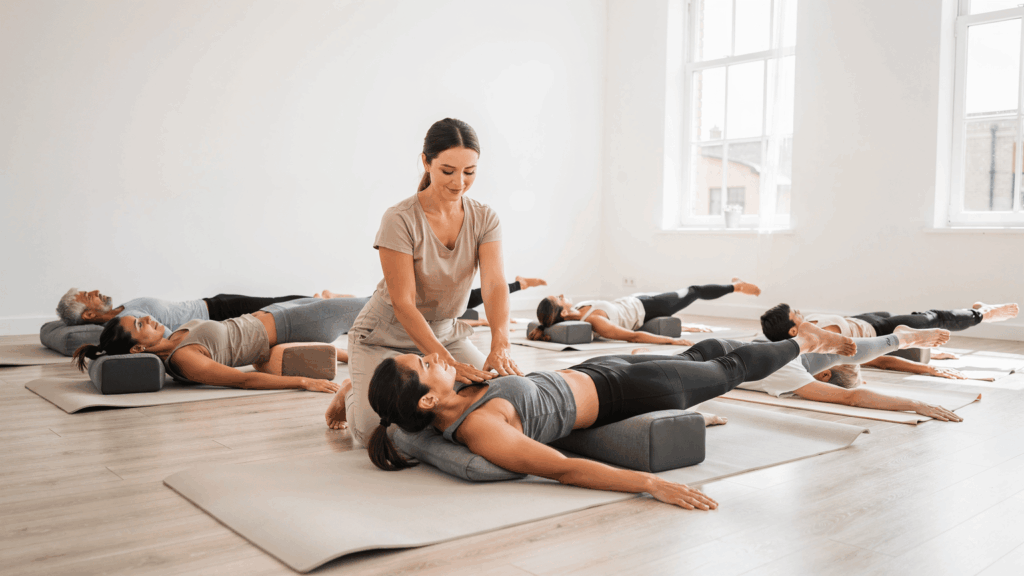
For most beginners, the first Pilates session feels very different from what they expect. The pace is calm, the movements look simple, yet the body reacts quickly. This contrast is normal and intentional.
You won’t be pushed to exhaustion. Instead, you’ll be guided to move slowly, with control, while focusing on breathing and alignment. Instructors usually demonstrate each exercise and offer modifications, so beginners are never left behind.
Common sensations during the first sessions
Many beginners notice:
- A deep core activation, especially around the abdomen and lower back
- Mild shaking in the legs or arms during static holds
- A feeling of mental concentration rather than physical overload
These sensations are not signs that Pilates is too hard. They simply reflect the engagement of muscles that are rarely activated consciously.
Can Pilates be adapted for complete beginners?
Yes adaptability is one of Pilates’ strongest advantages. Every movement can be:
- Simplified
- Shortened
- Supported with props (blocks, cushions, resistance bands)
Instructors often encourage beginners to work at 50–60% intensity, prioritizing form over range of motion. This approach reduces injury risk and builds confidence quickly.
Checklist for beginners:
- Move slowly and breathe continuously
- Stop before pain, not after
- Focus on control, not flexibility
How long before Pilates feels easier?
Most beginners report that Pilates feels noticeably easier after 3 to 5 sessions. Movements become smoother, breathing more natural, and muscle activation more intuitive.
This short adaptation phase explains why Pilates may feel challenging at first but rarely stays difficult for long.
Does Pilates get harder over time?
Pilates does not become harder in a stressful or overwhelming way. Instead, it becomes more precise. As beginners gain control and confidence, exercises evolve through:
- Longer holds
- Greater range of motion
- Increased coordination
The difficulty progresses only if you choose it. This makes Pilates sustainable and motivating rather than intimidating.
Who may find Pilates more challenging at the beginning?
Some profiles may feel more challenged initially:
- People with poor posture awareness
- Those used to high-impact or fast-paced workouts
- Beginners who struggle with breathing control
That said, Pilates remains safe. Difficulty comes from learning, not physical limitation. Within a few sessions, most beginners feel more comfortable and capable.
Is Pilates a good choice if you’re a complete beginner?
Absolutely. Pilates is one of the best entry points into physical activity because it teaches how to move correctly before pushing intensity.
For beginners, it offers:
- Low injury risk
- Scalable difficulty
- Fast improvements in body awareness
The key is patience. Pilates may feel unfamiliar at first, but it rarely stays difficult — and often becomes deeply rewarding.
Pilates is not difficult for beginners, but it is intentionally challenging in a controlled way. That balance is exactly what makes it effective, safe, and accessible for people starting their fitness journey.