Yes Pilates can build muscle, but not in the same way heavy weightlifting does. It primarily develops lean, functional muscle, improves muscle endurance, and enhances neuromuscular control. For beginners, deconditioned individuals, or those returning from injury, Pilates can lead to noticeable muscle gains. For advanced lifters, it’s better viewed as a complement rather than a replacement for traditional strength training.
Pilates emphasizes controlled resistance, time under tension, and precise movement. These elements stimulate muscle fibers especially the deep stabilizers while minimizing joint stress. The result is often described as a “long and lean” look, driven by improved posture, muscle tone, and coordination rather than large increases in muscle size.
Key takeaways:
- Pilates builds lean muscle and strength through controlled resistance.
- It improves muscle endurance more than maximal power.
- Visible results depend on frequency, intensity, and your starting level.
What “building muscle” really means in Pilates
Muscle growth also called hypertrophy occurs when muscle fibers are challenged beyond their usual capacity and given enough recovery and nutrition. Pilates does this differently from barbells or machines.
Instead of heavy external loads, Pilates relies on:
- Bodyweight resistance
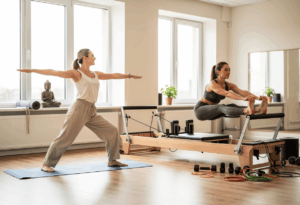
- Spring-based resistance (on reformers and other apparatus)
- Isometric holds and slow eccentrics
- High-quality repetitions with constant tension
This approach targets Type I (slow-twitch) fibers and smaller stabilizing muscles that are often undertrained. While these fibers don’t grow as large as Type II fibers, they play a major role in postural strength, joint stability, and movement efficiency.
Which muscles does Pilates strengthen most?
Pilates is famous for its emphasis on the core, but its reach goes far beyond the abs. A well-designed session strengthens multiple muscle groups simultaneously through integrated movement patterns.
Core and trunk muscles
These include the transverse abdominis, obliques, multifidus, and pelvic floor. Strengthening them improves spinal support and creates the foundation for all other movements.
Lower body
Pilates effectively targets:
- Glutes (especially gluteus medius)
- Hamstrings
- Quadriceps
- Inner thighs (adductors)
Because many exercises are performed unilaterally or with long lever arms, the lower body often works under continuous tension, which is favorable for muscle endurance and tone.
Upper body
Arms and shoulders are trained through:
- Plank variations
- Push-up patterns
- Resistance from springs or bands
While the loads are lighter than in traditional lifting, the time under tension can be substantial enough to challenge the shoulders, triceps, and upper back.
Why Pilates feels hard even without heavy weights
Here’s the nuance many people miss: muscle growth isn’t only about load—it’s also about control and fatigue.
Pilates increases:
- Time under tension (slow, controlled reps)
- Motor unit recruitment through precision
- Muscle activation efficiency
A single exercise performed slowly for 45–60 seconds can place more cumulative stress on a muscle than multiple fast repetitions with heavier weight. This is why Pilates sessions often feel deceptively challenging, even for experienced athletes.
In other words, Pilates may not maximize muscle size, but it strongly improves muscle quality how effectively your muscles work together.
How much muscle can Pilates actually build?
Pilates does build muscle, but the amount depends on who you are and how you practice.
For beginners, people returning after a break, or those with low baseline strength, Pilates can lead to visible muscle gains within 6–8 weeks. Improved tone in the abs, glutes, thighs, and shoulders is common because previously underused muscles are suddenly activated with precision.
For already trained individuals, Pilates builds muscle endurance and definition, not large increases in muscle size. It refines what’s already there rather than dramatically adding mass.
A simple guideline:
- New or deconditioned → yes, noticeable muscle growth
- Moderately active → better tone and firmness
- Advanced lifters → maintenance + balance, not bulk
Key data: Muscle growth requires progressive overload; Pilates provides it mainly through longer tension and precision, not heavy load.
Pilates vs weight training for muscle building
| Aspect | Pilates | Weight training |
| Muscle size | Moderate | High |
| Muscle tone | High | High |
| Endurance | Very high | Moderate |
| Joint stress | Low | Variable |
| Posture & balance | Excellent | Limited |
Pilates is especially effective if your goal is a lean, athletic look, better posture, and fewer imbalances. If your priority is maximal hypertrophy, heavy resistance training remains superior.
Which type of Pilates builds the most muscle?
Not all Pilates methods stimulate muscle in the same way. If muscle development is your goal, intensity and resistance matter.
Reformer Pilates
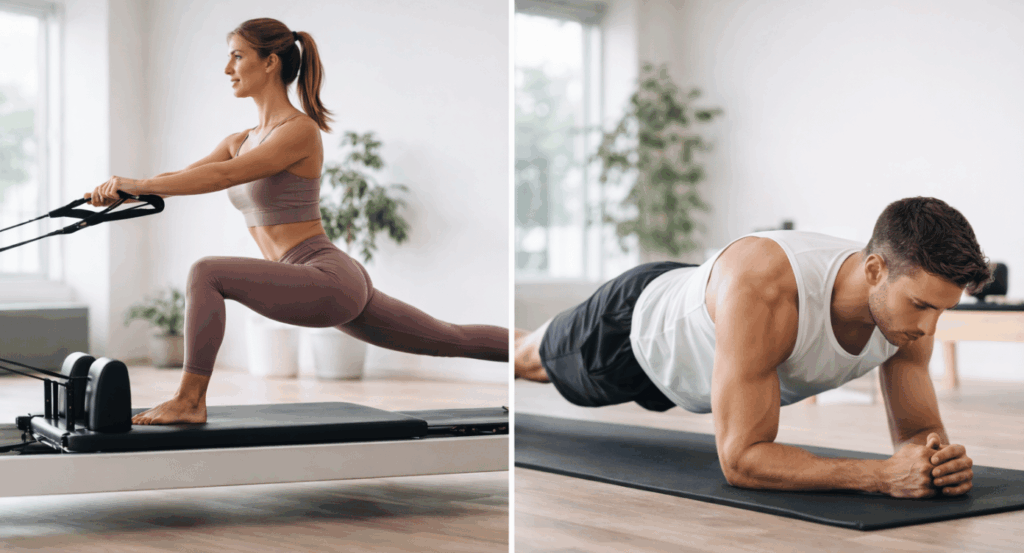
This is the most effective option for building muscle. The springs create progressive resistance, allowing overload similar to light strength training. Expect stronger glutes, legs, arms, and a more defined core.
Mat Pilates
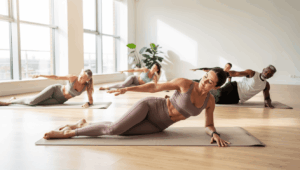
Mat-based classes rely mostly on bodyweight. They build muscle endurance and control, with visible toning, but less hypertrophy than reformer work.
Frequency that works
- 2 sessions/week → tone and maintenance
- 3–4 sessions/week → measurable strength gains
- 5+ sessions/week → endurance-focused, diminishing returns for growth
A key nuance: training slowly to fatigue matters more than adding more sessions.
Final verdict : does Pilates build muscle?
Yes, Pilates builds muscle but in a specific way. It develops lean, functional muscle, improves muscle endurance, and enhances body control. You won’t gain bulky size, but you will become stronger, more stable, and more defined.
Pilates works best if you:
- Want a lean, toned look
- Prefer low-impact training
- Need better posture, balance, and joint support
- Are returning to exercise or cross-training with another sport
It’s less effective if your main goal is maximum muscle size. In that case, combining Pilates with traditional resistance training delivers better results.
One final nuance that matters: Pilates becomes a muscle-building stimulus only when sessions are challenging. Slow tempo, controlled range, and training close to fatigue are non-negotiable.
Bottom line
Pilates absolutely contributes to muscle development just not through heavy load. If you train with intent and consistency, the strength gains are real and sustainable.