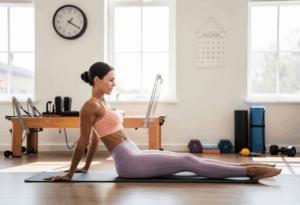
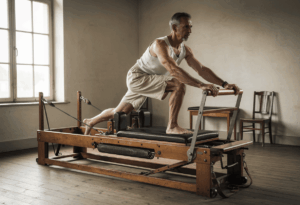
Pilates was invented in the early 20th century, around 1920, by a German physical trainer named Joseph Pilates. Originally designed as a method to strengthen the body, improve posture, and support rehabilitation, Pilates has since evolved into one of the most widely practiced mind-body disciplines in the world.
At its core, Pilates was not created as a fitness trend. It was developed as a system of controlled movement, deeply rooted in anatomy, breath control, and functional strength. Understanding when Pilates was invented helps clarify why the method still emphasizes precision, alignment, and injury prevention today.
Key takeaways:
- Pilates was invented around 1920.
- The method was created by Joseph Pilates.
- Its original goal was rehabilitation and physical control.
Pilates emerged at a time when physical culture was gaining importance in Europe and the United States. Unlike traditional strength training of the era, Pilates focused on quality of movement rather than quantity, encouraging balance between strength, flexibility, and breath.
This historical context explains why Pilates is still recommended today for people recovering from injuries, dancers, athletes, and individuals seeking long-term physical health rather than short-term performance gains.
Who developed Pilates and why?
To fully answer who developed Pilates, we must look at the life of its creator. Joseph Pilates was born in Germany in 1883 and grew up suffering from asthma, rickets, and rheumatic fever. These early health challenges shaped his lifelong interest in physical conditioning and anatomy.
During World War I, while interned in England, he began refining a system of exercises aimed at keeping the body strong even in confined conditions. He famously adapted hospital beds with springs to help injured patients regain mobility a concept that later influenced modern Pilates equipment.
This period was pivotal in shaping what Pilates would become: a method designed to restore natural movement, not just build muscle.
Where did Pilates originate?
Understanding where did Pilates originate is key to grasping its philosophy. The method was first conceptualized in Europe, but it truly took shape after Joseph Pilates moved to the United States in the 1920s.
He settled in New York City, where he opened a studio with his wife Clara. The studio quickly became popular among dancers and performers who needed a reliable way to strengthen their bodies without overloading joints. This artistic and rehabilitative environment strongly influenced the refinement of Pilates as a full-body conditioning system.
The early adoption of Pilates by dancers explains why control, flow, and alignment remain central principles of the method today.
How Pilates evolved after its invention
After Pilates was invented, the method did not spread immediately to the general public. Its early development was gradual and highly specialized. In the 1920s and 1930s, Pilates remained closely tied to rehabilitation, posture correction, and movement efficiency rather than mass fitness.
Joseph Pilates originally called his method “Contrology”, emphasizing the idea that movement should be controlled by the mind. This concept set Pilates apart from other physical training systems of the time, which focused mostly on strength or endurance.
The exercises were structured around a few essential principles:
- Breath control
- Precision of movement
- Core stability
- Postural alignment
These foundations still define Pilates today and explain why it is often used in physical therapy and injury prevention.
The role of equipment in early Pilates
One distinctive aspect of Pilates was the use of specialized equipment. Joseph Pilates designed spring-based machines to guide movement and provide resistance without impact. These devices helped practitioners strengthen muscles while protecting joints.
This innovation made Pilates particularly attractive for:
- Injured patients
- Dancers in recovery
- Individuals seeking low-impact training
Over time, these machines became a defining feature of Pilates studios worldwide.
How Pilates spread worldwide
Although Pilates was invented in the early 20th century, it remained relatively unknown outside a small professional circle for several decades. Its expansion happened mainly after the 1960s, when former students of Joseph Pilates began teaching the method independently.
These early instructors played a crucial role in transmitting the original principles while adapting the practice to different audiences. Pilates gradually reached:
- Rehabilitation centers
- Dance schools
- Athletic training programs
This period marked a shift from a niche method to a recognized mind-body discipline.
From Contrology to modern Pilates
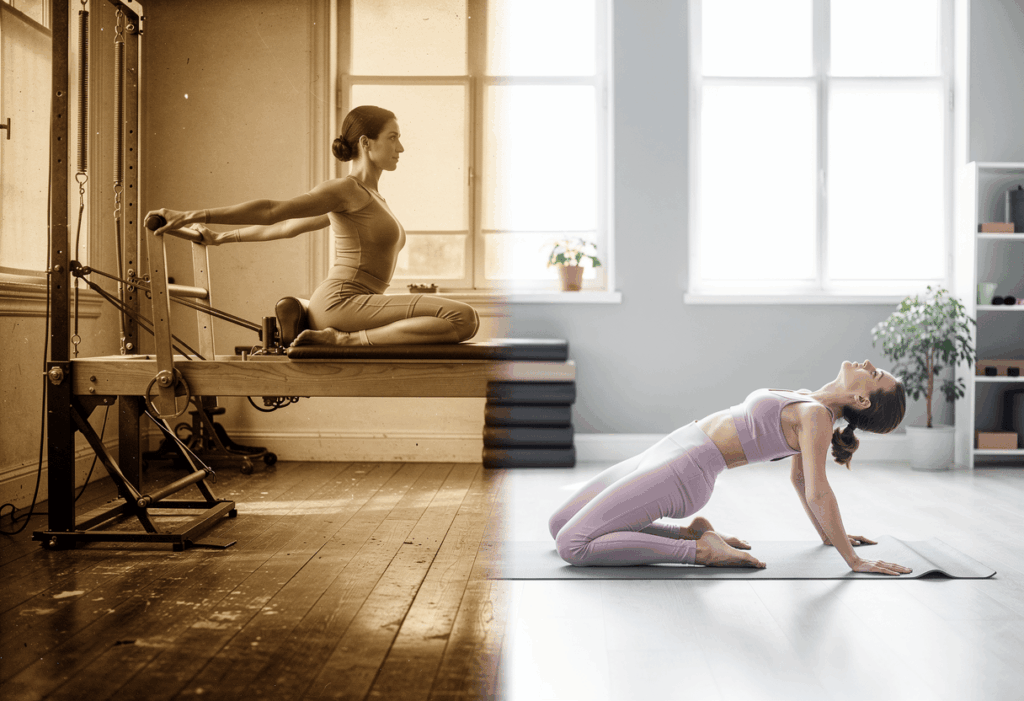
The term “Contrology” slowly faded as Pilates became more accessible to the public. However, the core philosophy remained the same: movement with intention, control, and efficiency.
Modern Pilates classes may vary in style, but they still rely on the original concepts developed by Joseph Pilates. This continuity explains why Pilates is often perceived as both traditional and modern at the same time.
Why the origins of Pilates still matter today
Understanding when Pilates was invented helps explain why the method remains so relevant in modern movement practices. Created around 1920, Pilates was never meant to be a quick fitness solution. It was designed as a long-term system for physical balance, posture, and functional strength.
Unlike many training trends, Pilates is built on principles that do not change with time:
- Controlled movement over intensity
- Quality of execution over repetition
- Mind-body connection
These fundamentals make Pilates suitable for a wide range of people, from beginners to athletes.
A brief recap of Pilates history
Pilates was invented in the early 20th century by Joseph Pilates, initially as a method to restore strength, posture, and movement control. Developed first in Europe and later refined in New York, the method was never intended as a fitness trend, but as a structured system focused on long-term physical balance.
Originally known as Contrology, Pilates emphasized mindful movement, precise execution, and deep core engagement. These principles have remained unchanged over time, even as the practice has evolved and adapted to modern lifestyles.
Today, Pilates continues to be practiced worldwide not because it follows trends, but because its foundations are timeless. Its history explains why Pilates is still valued for rehabilitation, injury prevention, and sustainable physical conditioning more than a century after it was first invented.