Short answer: Yes, Pilates can count as resistance training but not in every context and not for every goal. Pilates uses body weight, controlled tension, and sometimes equipment to create resistance, which stimulates muscles. However, its effects differ from traditional strength training, especially when hypertrophy or maximal strength is the objective.
Before diving into nuances, let’s clarify what “resistance training” actually means and where Pilates fits within that definition.
Key takeaways:
- Pilates uses resistance, mainly through body weight and controlled tension.
- It develops strength endurance, stability, and neuromuscular control.
- It is not equivalent to heavy-load strength training for muscle growth.
What defines resistance training?
Resistance training refers to any exercise that causes muscles to contract against an external force. This force can come from:
- Body weight
- Gravity
- Resistance bands
- Springs, cables, or weights
The goal is to create mechanical tension, which challenges muscle fibers and leads to strength adaptations over time.
Classic examples include weightlifting, resistance machines, or bodyweight exercises like squats and push-ups. However, resistance training is not defined by equipment, but by muscle loading and tension.
How Pilates creates resistance
Pilates relies on slow, controlled movements, precise positioning, and continuous muscular engagement. Resistance is generated through:
- Body weight leverage (especially in mat Pilates)
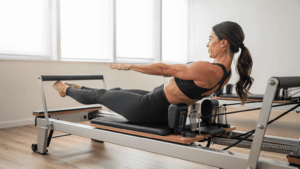
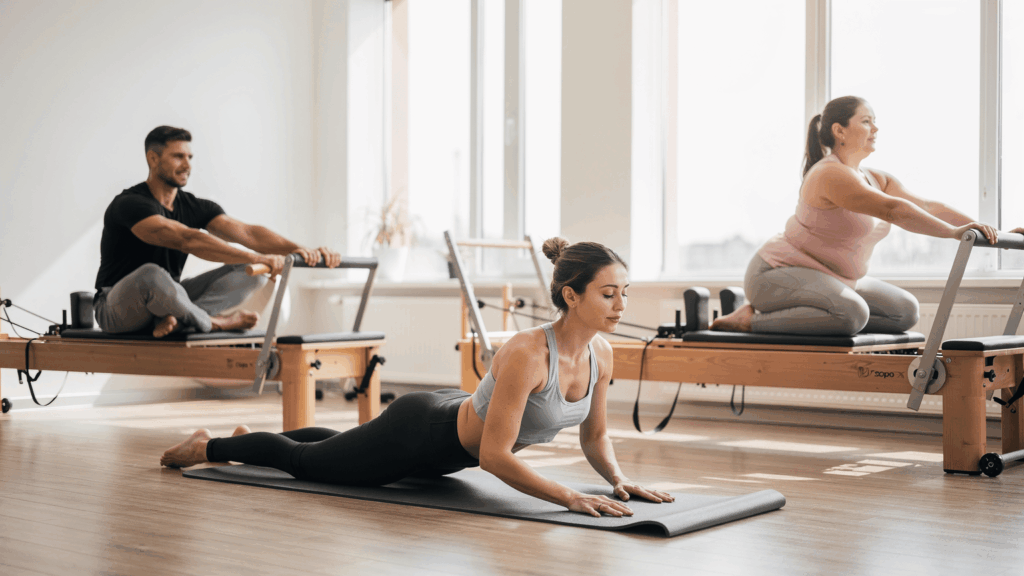
- Spring-loaded equipment such as the Reformer or Cadillac
- Time under tension, with long eccentric phases
- Isometric holds that challenge deep stabilizing muscles
Rather than focusing on lifting heavier loads, Pilates emphasizes movement quality, alignment, and muscular control. The resistance is often moderate, but sustained.
This approach makes Pilates particularly effective for improving core strength, postural muscles, and joint stability which are sometimes undertrained in traditional gym programs.
How Pilates compares to traditional strength training
To understand whether Pilates truly qualifies as resistance training, it helps to compare it with traditional strength training in terms of muscle stimulus, load, and adaptation.
Both approaches use resistance, but they stress the body differently.
Load and intensity differences
Traditional strength training typically relies on external loads that can be progressively increased over time. This progressive overload is one of the main drivers of muscle hypertrophy and maximal strength.
Pilates, on the other hand, usually involves:
- Low to moderate resistance
- Higher emphasis on control and precision
- Longer time under tension, but with lighter loads
Because of this, Pilates does not consistently reach the mechanical tension levels required for significant muscle size gains in most individuals.
Key data : Muscle hypertrophy is strongly associated with mechanical tension and progressive overload, which Pilates provides only to a limited extent.
Type of strength developed with Pilates
Pilates primarily develops:
- Strength endurance, not maximal strength
- Postural strength, especially in deep stabilizing muscles
- Neuromuscular coordination, improving how muscles work together
This makes Pilates extremely valuable for movement efficiency, injury prevention, and long-term joint health.
However, it does not aim to maximize force production. Instead, it focuses on sustained control, breathing, and alignment elements often missing in high-load training.
Muscle activation vs muscle overload
Pilates is excellent at activating muscles, particularly those that are hard to target voluntarily, such as the transverse abdominis or deep spinal stabilizers.
But muscle activation alone does not equal muscle growth.
For muscles to grow stronger and larger, they must experience progressively increasing resistance. In Pilates, progression usually comes from:
- More complex movement patterns
- Increased range of motion
- Better control and tempo
While beneficial, these progressions are not equivalent to adding heavier resistance over time.
Is Pilates “enough” as a strength workout?
The answer depends entirely on who you are and what you expect from your training.
Pilates may be sufficient if your goals include:
- Improving core strength and stability
- Enhancing posture and body awareness
- Building baseline muscular endurance
- Supporting rehabilitation or injury prevention
However, Pilates alone may be insufficient if your primary goal is:
- Significant muscle hypertrophy
- Maximal strength development
- Bone density optimization through high-impact loading
Who benefits most from Pilates as resistance training?
Pilates can absolutely function as resistance training for certain profiles especially when the goal is not maximal strength, but control, stability, and movement quality.
Beginners and sedentary individuals
For beginners, Pilates provides enough resistance to stimulate muscles safely. Bodyweight leverage and controlled tension are sufficient to:
- Build baseline strength
- Improve coordination and balance
- Reduce injury risk when returning to movement
In this context, Pilates clearly counts as resistance training.
People focused on core and posture
Pilates excels at strengthening the deep core muscles that support the spine and pelvis. This includes muscles often undertrained in classic gym routines.
For individuals dealing with:
- Postural issues
- Back discomfort
- Desk-related stiffness
Pilates offers targeted resistance that improves functional strength, not just appearance.
Athletes using Pilates as a complement
For athletes, Pilates is best viewed as a supportive form of resistance training, not a replacement.
It helps with:
- Joint stability
- Movement efficiency
- Better force transfer between limbs
However, it does not replace heavy resistance work needed for power or hypertrophy.
When Pilates alone may not be enough
Pilates may fall short if the primary goal is:
- Building visible muscle mass
- Increasing maximal strength
- Maximizing bone density through high-load stress
In those cases, Pilates works best when combined with traditional strength training.
In Summary
Yes, Pilates does count as resistance training, because it uses body weight, controlled tension, and sometimes springs to challenge muscles.
However, it mainly develops strength endurance, core stability, and postural control, rather than maximal strength or muscle size.
Pilates is enough on its own for beginners, people returning to exercise, or anyone focused on movement quality and joint health.
For goals like muscle hypertrophy or maximal strength, Pilates works best when combined with traditional strength training.
Pilates builds functional strength not bulk and fits perfectly as a complementary resistance method.