A Pilates ring (also called a magic circle) is a simple yet powerful prop designed to increase muscle activation, improve alignment, and enhance control during Pilates workouts. The basic rule is straightforward: you place the ring between or around your limbs and apply gentle pressure to engage stabilizing muscles. From there, technique and intention make all the difference.
Unlike heavy equipment, the Pilates ring relies on isometric resistance, which means muscles work without large movements. This makes it suitable for beginners while still challenging for advanced practitioners.
Key takeaways:
- The Pilates ring adds resistance without impact.
- Proper placement is essential for effectiveness.
- Slow, controlled movements matter more than force.
What Is a Pilates Ring and Why Use It?
The Pilates ring is a lightweight circular prop with padded handles on each side. It was originally designed to promote inner-thigh engagement, but it is now widely used for full-body conditioning.
Its main benefits include:
- Improved muscle awareness, especially in the core
- Deeper engagement of the inner thighs, arms, and chest
- Joint-friendly resistance, ideal for low-impact training
- Postural support, helping maintain proper alignment
Because resistance comes from squeezing or pressing outward, the ring encourages balanced muscle activation, which is a core principle of Pilates.
How to Hold and Position a Pilates Ring Correctly
Correct positioning is what transforms the ring from a simple accessory into an effective training tool. The ring can be placed in several common positions, depending on the exercise and targeted muscles.
Between the thighs
This position is often used to activate the inner thighs and pelvic floor. The ring should sit just above the knees, with gentle inward pressure applied during controlled movements.
Between the ankles
Placing the ring lower increases lever length, making exercises more challenging for the core and hip stabilizers.
Between the hands
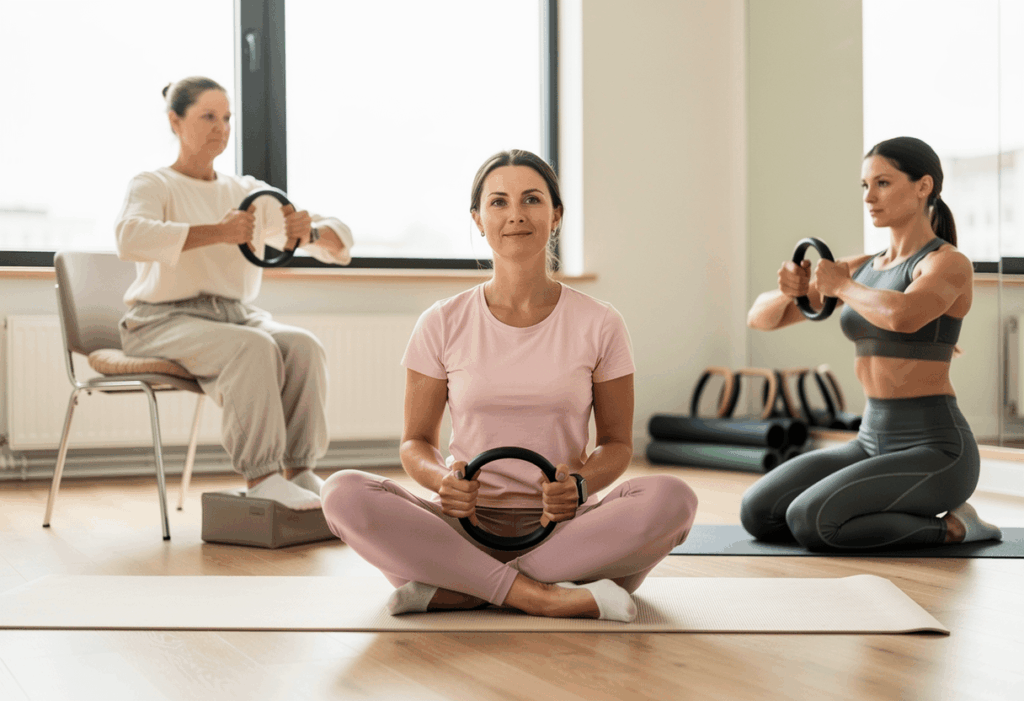
Holding the ring at chest level helps engage the arms, shoulders, and chest, while also encouraging proper spinal alignment.
Outside the legs or arms
Pressing outward against the ring shifts focus to outer thighs or shoulder stabilizers, adding variety and balance to workouts.
Practical checklist :
- Keep shoulders relaxed and away from the ears.
- Engage the core before applying pressure.
- Use controlled breathing throughout each movement.
How Much Pressure Should You Apply?
One common mistake is squeezing the ring too hard. In Pilates, control matters more than force. The goal is to maintain steady, moderate resistance while moving with precision.
Applying excessive pressure can lead to:
- Loss of proper alignment
- Over-recruitment of dominant muscles
- Reduced engagement of deep stabilizers
A useful guideline is to apply about 30–50% of your maximum strength. This keeps muscles active without tension overload and allows you to sustain movements with proper form.
Breathing Technique When Using a Pilates Ring
Breathing is a central element of Pilates and becomes even more important when adding resistance.
- Inhale to prepare and lengthen the spine
- Exhale during effort, especially when squeezing or pressing
This breathing pattern helps activate the deep abdominal muscles and reduces unnecessary tension in the neck and shoulders.
A calm breathing rhythm also improves coordination and makes exercises feel smoother and more controlled.
Beginner-Friendly Pilates Ring Exercises
When learning how to use a Pilates ring, starting with simple exercises helps build control and confidence. The goal is not intensity, but precision and muscle awareness.
Inner thigh squeeze
Sit or lie on your back with the ring placed between the thighs, just above the knees. Gently squeeze the ring as you exhale, then release slowly. This exercise activates the inner thighs and deep core muscles without stressing the joints.
Arm press
Hold the ring at chest height with both hands on the padded grips. As you exhale, press inward slightly, then release with control.
This targets the chest, arms, and shoulders, while encouraging proper posture.
Seated core engagement
Sit tall with legs bent and the ring between the ankles. Apply gentle pressure while maintaining an upright spine. This variation challenges core stability and improves lower-body control.
Common Mistakes to Avoid
Even simple movements can lose effectiveness if form is neglected. Watch out for:
- Over-squeezing the ring instead of maintaining steady resistance
- Holding the breath, which reduces core activation
- Shrugging the shoulders, especially during upper-body work
Pilates ring exercises should feel controlled, balanced, and fluid, not forced. If tension builds, reduce pressure and refocus on breathing.
How Often Should You Use a Pilates Ring?
The Pilates ring can be used 2 to 4 times per week, depending on your goals and experience level. Because it relies on low-impact resistance, it fits easily into most routines without overloading the joints.
- Beginners: 2 sessions per week to build awareness and control
- Intermediate practitioners: 3 sessions for strength and toning
- Advanced users: up to 4 sessions, integrated into full workouts
Using the ring regularly improves muscle activation rather than raw strength, which aligns with the core principles of Pilates.
Who Benefits Most from a Pilates Ring?
The Pilates ring is especially useful for people who want to:
- Strengthen the inner thighs and core
- Improve posture and alignment
- Add resistance without high impact
- Enhance mind–muscle connection
It’s also suitable during recovery phases, as long as movements stay controlled and pain-free.
Key data : Moderate resistance tools like the Pilates ring can increase muscle engagement without increasing joint stress.
When the Pilates Ring May Not Be Ideal
Although versatile, the Pilates ring may not be the best option if:
- You rush through movements without control
- You apply excessive pressure instead of steady resistance
- You have unresolved joint pain and skip proper guidance
In these cases, focusing on bodyweight Pilates first is often more effective.
Final Tips for Using a Pilates Ring Effectively
To get the most out of a Pilates ring, remember that quality always beats quantity. The ring is designed to refine movement, not overpower it.
Key principles to keep in mind:
- Apply gentle, consistent pressure, never maximal force
- Move slowly to maintain muscle control and alignment
- Coordinate each effort with calm, steady breathing
- Stop immediately if discomfort replaces controlled effort
Used correctly, the Pilates ring enhances core engagement, improves posture, and adds variety to both mat and home workouts.
Quick Summary: How to Use a Pilates Ring
- Place the ring between or around limbs depending on the muscle targeted
- Use moderate resistance to activate stabilizing muscles
- Practice 2–4 times per week for best results
- Focus on precision, breathing, and posture
The Pilates ring is a simple tool, but when used with intention, it becomes a powerful way to deepen your Pilates practice.